Il Globo, UNESCO recognition of Italian cuisine
“Italian cuisine as a connection to childhood memories and an act of peace”
December 18th, 2025
Some of Melbourne's leading restaurant industry figures have their say on the recent UNESCO recognition.
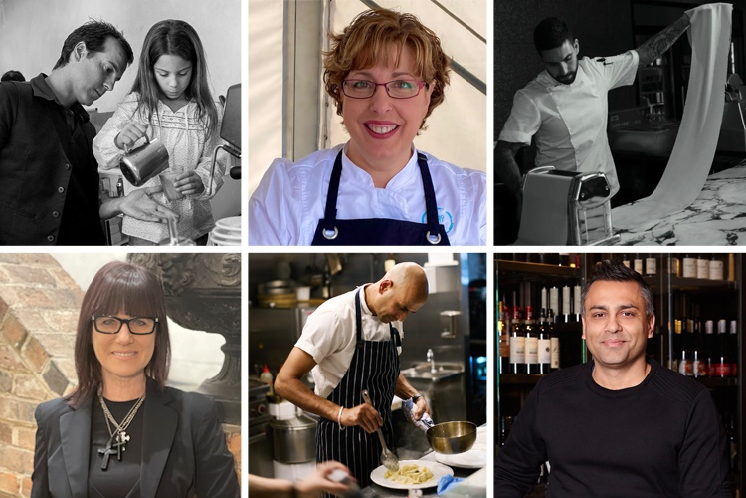
From left, top: Tony Nicolini and his daughter Simona, Pia Gava, Matteo Fulchiati, Caterina Borsato, David Lakhi and Johnny De Francesco
In the many years I've spent abroad, a comment I've often heard is that we Italians are a living paradox. While on the one hand we complicate our lives and always tend to see the negative side of things, on the other, when we sit down to eat, this way of being is completely overturned. It's right there, around the table, that problems cease to exist, that everything becomes simpler, that the family reunites, weapons laid down, and generations living so far apart manage to find common ground.
On the occasion of the recent proclamation of Italian cuisine as a UNESCO World Heritage Site, I spoke to some of Melbourne's leading Italian restaurants to hear their immediate reactions and understand how this high honor will impact the future of their businesses.
For Caterina Borsato, owner of the iconic Caterina's Cucina & Bar , Italy's gastronomic heritage goes far beyond regional tradition.
"This recognition goes to all the grandmothers and mothers who got up early on Sunday mornings to make tortellini and broth, or to cook cod. My restaurant was born precisely for this reason: since I was little, the most important moment for my family was always Sunday lunch, when we spent hours together at the table, eating and talking."
Borsato admits that times are different now, and while this ritual was possible simply because her mother was a stay-at-home mom, she couldn't offer the same to her daughter, being busy running a successful restaurant. "This restaurant is based on the concept of that long Sunday lunch. This is how I carry on that love and family tradition. When we were forced to close during the Covid period, I often thought of when my grandmother would sit in the garden and beat cod. And from there, I was inspired to bring this great traditional Venetian dish to the menu, just as my grandmother used to make it."
Though the conversation was brief, Borsato managed to open the door, and her heart, to her own dimension, which recently seems to be celebrated more than usual. "I don't know if it's because we received two toques from the restaurant guide, or because I won the Lifetime Achievement Award, or because of this UNESCO inclusion. Maybe it's a combination, but we've never been so full at both lunch and dinner!"
Tony Nicolini, chef and restaurateur, founder of the DOC empire and owner of Italian Artisans in Albert Park, believes this recognition represents a benchmark for the future of our cuisine. "While it's vital to follow tradition, it's equally important to leave room for new generations with their contemporary interpretations, while always respecting what the older generations have passed down to us."
For Nicolini, this, therefore, confirms the sacred act of passing down recipes, as well as offering renewed, unforced inspiration to young chefs, to continue with all the ancient flavors and rituals that are part of the very DNA of Italian culture. "After all, we don't cook to make a living. And this will further help us introduce Australians to a true way of life."
Matteo Fulchiati, a young chef originally from Parma, now helms the kitchen at Lagotto restaurant in North Carlton, echoes this sentiment . "Italian cuisine deserves this recognition from UNESCO because it is so diverse and has historic traditions, and this gives it greater importance and prestige, especially abroad."
According to Fulchiati, this is a historic moment for young chefs who are gaining experience in the kitchens of Italian restaurants around the world, and who are trying to do their best without having had direct experience in the field.
In my opinion, tradition absolutely must be carried forward. I do so in my kitchen, but I adapt it to 2025. One thing that can be improved in traditional Italian cuisine is the level of presentation. Our cuisine was born from the fact that it wasn't meant to be beautiful, it was meant to feed the family. Even without the aesthetics, however, the flavor and love have always been there. It's important to bring all these values into the restaurant world, with presentation, technique, and preserving the flavors and memories of the region.
Pia Gava , a former MasterChef contestant and author and organizer of successful masterclasses on fresh pasta and gnocchi, sees inclusion in the UNESCO list as an opportunity to safeguard Italian history and tradition.
Of all the cuisines in the world, Italian is one everyone touches. Which is fine, but some people, unfortunately, really compromise the original dish, like the famous carbonara. There are chefs and influencers who don't provide accurate information. To be recognized for what is correct, traditional, and part of a specific culture is an honor.
For Gava, honor extends to the way of life, the emotions that are poured into each dish, and the reasons why it was created, whether these are the result of necessity, or to celebrate a special occasion.
"When I teach a specific dish in my masterclasses, I always talk about its provenance, and how it can vary within the same region. And if I change it, I do so for a reason, whether it's related to the availability of a specific seasonal ingredient, or how my family used to prepare it. In any case, I'm very careful to inform the participants of this."
Johnny Di Francesco, World Pizza Champion and founder of 400 Gradi , is no stranger to UNESCO recognition. "I was very fortunate to have been part of the induction of Neapolitan pizza into UNESCO years ago. And seeing Italian cuisine now included is just another piece of the puzzle." For Di Francesco, Italian cuisine has a rich heritage, and it's crucial to continue to grow it outside of Italy, especially in Australia, home to one of the largest Italian communities in the world.
However, we must be wary of imitations: "All over the world, no matter where you go, Italian cuisine has always been slightly modified to suit local palates. I think this recognition will help protect it. It's like Champagne for France: we can't call a sparkling wine Champagne that doesn't come from Champagne."
Di Francesco adds that he sees this honor as a starting point for all restaurant and hospitality businesses.
The final word goes to David Lakhi, owner of Little Black Pig & Sons in Heidelberg. Having emigrated from India at the age of 19, Lakhi spent 12 years alongside the then seventy-four-year-old Clara Capucci in the family's Italian restaurant. This period not only passed down recipes from a culture far from his own, but also effectively made Lakhi an adopted son of Italian culture.
In his restaurant, which serves the typical "cucina povera" (poor man's cuisine) he learned from Clara, everything is handmade, from the pasta and bread to the gelato and the ladyfingers used in tiramisu. He has many customers, especially Italian tourists, whose simplicity has managed to tug at their hearts and bring a tear to their eyes. "In Australia, pizza and pasta are now staples. My children eat pasta with Bolognese sauce three times a week. When they grow up and make ragù, they will connect it with their childhood memories. And that's why, in my opinion, Italian cuisine was included in the UNESCO list. Because it connects people to their memories, and the simplicity of the cuisine is incredible. It doesn't take much to create a delicious dish and make people happy."
According to Lakhi, the simple act of eating together at the table is invaluable. “No one in my house starts eating until we're all seated. It's important to feed the stomach, but feeding the soul is even more important. Because that's how you bring peace, especially considering what's happening in the world. The planet is very fragile right now, and what we need is food, and music, to bring people together, break bread together, and find some kind of peace.”